

.png)
BEL20 index peaks eighteen years after previous record
The Bel20 index on the Brussels stock exchange set a record last week, no less than eighteen years after the previous one. That's not a reason to party. The index has its merits, but certainly also its shortcomings, as its history shows.
Last Friday, the Bel20 — the index of the most important twenty Belgian listed companies — reached a record price of 4,796 points. The previous record dates back to May 2007. Trends asked a few analysts and fund managers, with more than a century of experience in Belgian stocks, about the Belgian index's trajectory over the past twenty years and the significance of that record.
The Bel20 dived from a high of 4,757 points in May 2007 to a low of 1,527 points in March 2009. Other European and especially US indexes rose from the trough much faster after the 2008 financial crisis. The US S&P500 took five and a half years, the German DAX just under six years. The Dutch and French stock market indexes went through their pre-crisis record in 2021.
Wrong mix
The financial crisis therefore had a harder impact on the Belgian star index. “Back then, KBC, Fortis and Dexia had a significant weight in the index together. Those financial institutions all fell sharply and that made a rapid recovery difficult. KBC survived and is now one of the better-capitalized and most profitable banks in Europe. Dexia disappeared, Fortis barely survived and later became Ageas,” says Patrick Millecam, manager of, among other things, the Belgian equity fund at the independent asset manager Value Square. KBC only recently broke through its record price of 2007. Ageas is still trading at a fraction of the prices of the late Fortis.
The brewer AB InBev, with an index weight of 10 to 12 percent, has curbed the price increase in the past ten years. “If a heavyweight like that doesn't do well, the index can't top either. Since taking over SAB Miller, the beer giant has been over-indebted. The free cash flow mainly flowed into deleveraging and not to shareholders,” says Patrick Vermeulen, asset manager at Ascot House. In addition, the Bel20 missed the sectors that excelled. “The index is strongly focused on traditional value stocks with limited growth potential but high dividends, which weighs on the index's price. Unlike other indexes, such as the S&P500, the Bel20 lacks fast-growing sectors, such as technology, defense, and luxury,” said Wim Lewi, head of equity research at KBC Securities.
The same, but different
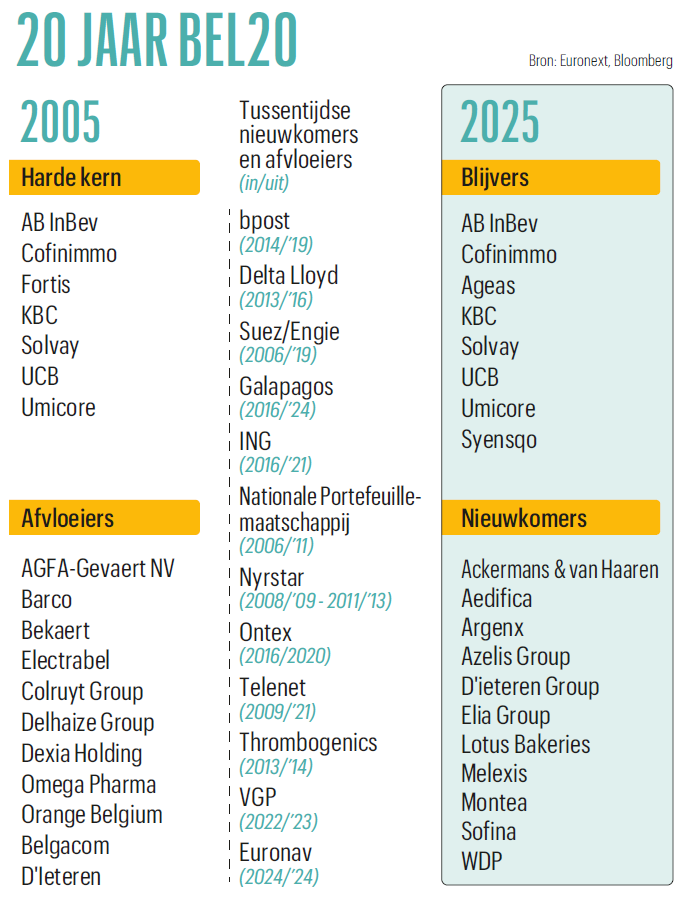
Has the Bel20 changed much in those twenty years? Yes and no, it sounds. “In any case, he is better diversified across the sectors,” says Patrick Millecam. Nine companies are the same as in 2006 — ten, if we include Syensqo as Solvay's sister company. “Those stayers account for 65 percent of the index weight. The big blocks haven't changed much. The newcomers include a number of stock market successes in recent years, such as argenx, Melexis and Lotus. And with WDP, Aedifica and Montea, there is much more real estate in the Bel20 than two decades ago,” says the Value-Square manager.
On the downside, the index once included failures such as Agfa-Gevaert, bpost, Galapagos, Ontex and Nyrstar, in addition to a number of runoffs, such as Barco, Orange, Delhaize, Colruyt and Bekaert.
Holdings or investment companies are now weighing heavily in the Bel20. In 2006, that was only GBL by the late Albert Frère. A year later, Ackermans & van Haaren was added, and even later Sofina and d'Ieteren. “Do they have a place in such an index?” , asks Patrick Vermeulen. “They are investment vehicles owned by the controlling families, without their own industrial activity. The British stock market indexes do not include such investment funds. You can still defend D'Ieteren and Ackermans & van Haaren's place, because they are co-driving the companies in which they invest.”
Composition must be more dynamic
A stock index performs only as well as the underlying stocks. The composition is therefore decisive, but it follows rules about, among other things, freely tradable stocks and market value. “The composition changes too slowly. A company has to do well for years before it can win a seat in the Bel20. A lot of upside potential has already been realized at that time,” says Patrick Vermeulen, who gives Lotus Bakeries as an example. “The cookie baker did a fantastic job, but due to limited trading volumes, a Bel20 seat was long overdue. The company was actually punished because it has loyal shareholders. When Lotus finally got into the Bel20, the stock took a hit in the wake of a temporary slowdown in growth.”
Patrick Millecam, on the other hand, gives chip developer Melexis as an example. “Every year, we look at which stock exchange companies achieve the greatest value creation, and Melexis has been in the top three for ten years. But the stock had already risen significantly when it finally entered the Bel20,” he says. “In 2021, it came in with a price of 84 euro. A year later, it went down to 83, only to get back to 100 euro in 2023. Currently, the share costs around 67 euro. Investors who hoped to benefit from Melexis' stock market performance via the Bel20 are well worth it. While the stock has posted an annual return of 16 percent since its IPO in 2002, compared to 4.5 percent for the Bel20 over the same period.”
The composition rules also oppose the performance of the index in reverse, says Patrick Vermeulen. “It also takes a long time for a company to lose its seat. Weak brothers will rule the roost for a long time, instead of giving way to promising companies,” he says. “It's also not easy to replace dying stars. That requires a dozen new promising companies, but fresh blood is scarce. Such companies are also more likely to seek funding in private markets or in the US. With D'Ieteren, Sofina, Lotus and Elia, we have strong companies in the index, but they are not substitutes for an AB InBev with a market capitalization of almost 100 billion euros,” says Kris Kippers, head of equity research at Degroof Petercam.
20 is too little, but more is not better
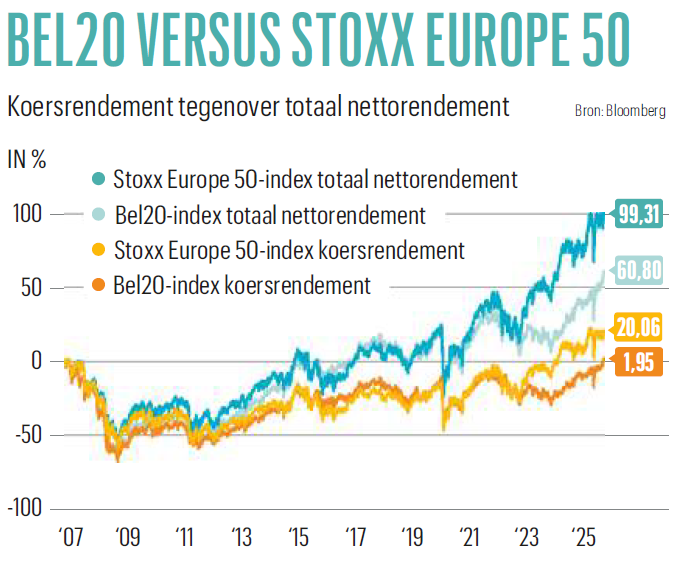
This raises the question of the relevance of the Bel20. Patrick Millecam warns against taking on the Bel20 as a dipstick for Belgian stock market performance. “Many Belgian stock exchange companies pay dividends. You should count that in the price return. That gives a more accurate and honest picture,” he says. The total net return — i.e. price evolution plus dividends minus dividend taxes — of the Bel20 since 2007 has been 60 percent. That's not shamefully lower than the 90 percent of the Stoxx Europe 50. “Thanks to the very strong performance of a number of European banks and outliers such as Siemens and Airbus, the latter has been doing much better, especially since the end of 2022. The real estate companies in the Bel20 have been weighing on the evolution caused by the rise in interest rates since 2022,” says Patrick Millecam.
Since its creation in 1991, the total return of the Bel20 — price evolution plus dividends — has averaged 8 percent per year. There are also questions about the number of companies in the Belgian star index. “Twenty companies as a basis for an index is not enough. The concentration is high, so company-specific developments have a major impact on the whole,” says Patrick Vermeulen. The largest ten companies in the Bel20 account for 75 percent of the index weight. Gut feeling would say that the Belgian All Shares, with its 116 companies, is a better alternative. “But that's not true,” says Patrick Millecam. “There, too, the top ten accounts for 75 percent of the weight, just like in the Bel20. Moreover, only 53 percent of Bel All Shares companies are truly Belgian. The rest are shares in companies that were once Belgian but were sold to foreign players who have retained their listing in Brussels. Albert Frère was the motive behind this, for example by selling Petrofina to Total Energies. That makes up 17 percent of Bell All Shares.”
Plus, the All Shares hasn't fared much better than the Bel20. “His total net return since 2007 has been 71 percent, compared to 60 percent for the Bel20,” says Millecam.
Wim Lewi also points to external changes that have affected the Bel20 in recent years. “The index used to be more prominent when institutional investors focused even more on individual countries. In addition, there are far fewer derivatives, such as options and futures, associated with the Bel20, which is therefore less prestigious,” he says.
Wanted: Belgian stock market indicator
Indexes are the indicators against which fund managers measure their performance. But the Belgian indexes fall short of that. “The top four in the Bel20 have a weight of 46 percent. That is far too high for fund managers, because they are only allowed to invest a limited percentage of their portfolio in one stock,” says Kris Kippers. “Most Bel20 companies have too low a market capitalization and a low tradability to be of interest to fund managers. Outside the top seven, the other Bel20s are actually small- and mid-caps, especially in the eyes of Anglo-Saxon investors. Aedifica and Cofinimmo are merging to improve their attractiveness to major investors.” According to Patrick Millecam, too, the liquidity of the shares in an index is more important than the number of stocks that comprise it. “According to the rules, a share cannot exceed 10 percent of a fund portfolio and all positions higher than 5 percent combined cannot exceed 40 percent. Stocks also need to be sufficiently liquid to get in and out quickly enough. That is why no index is suitable as a reference for Belgian fund managers,” he says.
The smallest fund with only Belgian shares has 40 million euros under management. Of the 110 Belgian stocks, only 23 are sufficiently liquid to hold.
one day to get on or off. For 18 stocks, that would be possible in one to five days. For the smallest Belgian stock fund, only about 40 shares are eligible to invest in. The larger the fund, the smaller the choice becomes. That is why the larger Belgian equity funds are also closer to the BEL20 index, which contains the larger liquid names. As a result, the landscape of funds that only invest in Belgian stocks has changed significantly in the past twenty years.
“In 2007, there were still thirty such funds, with a total of 3 billion euros under management. All major banks had several at the time, as well as many smaller independent players. Now there are seven more, who together manage 560 million euros. That is 0.18% of the assets of all investment funds on the market in Belgium,” says Patrick Millecam.
Finally, the question remains whether it will stay with this record for the Bel20. “It could be a harbinger of a rediscovery of the index. The strong performance of biotech and European banks could push the index higher. Although a lot will depend on geopolitical tensions and the evolution of interest rates,” says Wim Lewi.
References:
Source: Trends
Link: https://trends.knack.be/beleggen/het-lelijke-eendje-boekt-eindelijk-nog-eens-een-record-bel20-piekt/
Authors: Jef Poortmans and Daan Killemans
Date: 21/08/2025
