


Guide your company through stricter investment rules
Since tax year 2026, large companies that want to invest in individual stocks in a tax-advantageous way must meet stricter conditions. Specific stock funds for entrepreneurs can benefit from this, although the rules have also been tightened for those funds.
The FBI regime - where DBI stands for permanently taxed income - allows companies to invest in other companies in a tax advantageous manner. The philosophy is that dividends that companies receive from company X in which they invest should not be taxed, because that company's profits have already been taxed.
The regime does have some conditions. For example, the investing company must either invest at least 2.5 million euros in company X or hold at least a 10 percent stake. The De Wever government has tightened the first condition somewhat. For large companies that do not hold 10 percent, it is no longer enough to invest at least 2.5 million euros. The investment must also be in the nature of a financial fixed asset (FVA), which means that a sustainable and specific relationship must be proven with the company in which they invest.
Nikolaas Van Robbroeck, tax attorney at Freshfields, provides some examples of when stocks are considered FVA. “This is the case if the company maintains a business relationship with the company in which it invests, or if the investment is made with a view to a strategic partnership. Another example is if the company develops technology that may be relevant to the investing company's business activity,” he says.
The FVA condition does not apply to small companies. These are companies that exceed a maximum of one of the following criteria: 50 employees, an annual turnover of 11.25 million euros and a total balance sheet of 6 million euros. Companies that exceed more than one criterion can continue to benefit from the FDI regime if they either increase their participation to 10 percent or combine their stake of (at least) 2.5 million euros with a sustainable relationship.
DBI funds
Another alternative is to switch to DBI funds. These are equity funds that are marketed specifically for companies. The fund manager then selects the shares. The funds offer the benefits of the DBI regime, while your company is not bound by the 2.5 million euro condition or the 10 percent stake.
However, the funds must distribute at least 90 percent of their income in the form of a dividend, and they offer the tax advantage insofar as they invest in companies that have undergone a normal tax regime. In that case, an exemption applies to dividends that the corporate investor obtains from the DBI fund. This also applies to the capital gain when selling to the fund.
However, the fund will withhold 30 percent withholding tax on the dividends paid. In order to recover withholding tax, the De Wever government has introduced a stricter condition: the company that invests must grant a minimum remuneration (in principle 50,000 euros from tax year 2027) to at least one manager.
With two new FvA funds, Econopolis, among others, wants to focus on larger family offices and institutional investors, such as pension funds and insurers, who are no longer able to make use of the DBI regime due to the additional FVA condition. “The new institutional DBI bevek consists of a fund that invests in holdings (Capital Allocators) and a global equity fund (Econoshock Compounders). The management costs of both funds amount to 0.64 percent per year from a deposit of 250,000 euros and 0.29 percent from 25 million euros,” says manager Joren Van Aken.
Holdings
The funds are offered as AIF beveks, alternative funds, so they are not bound by European diversification rules. “This allows us to hold high-performing stocks for longer without having to constantly adjust our position. At the same time, it is a diversified investment, as it invests in holdings,” says Van Aken.
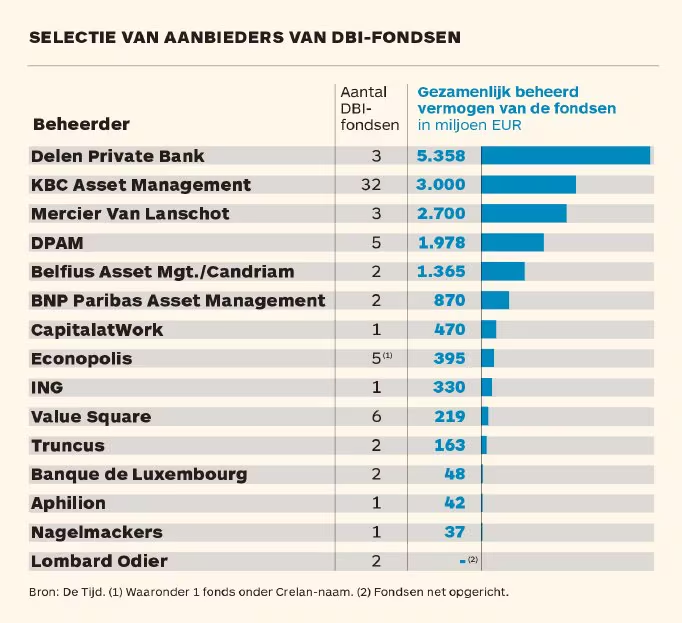
Lombard Odier is also coming up with two new DBI funds. “What is unique about the funds is that they use a strategy that is similar to an ETF or tracker, which allows them to pursue lower costs. For both the fund that invests in European stocks and the fund that invests in US stocks, the management costs are 0.45 percent for deposits over 10,000 euros, and 0.25 percent for deposits of more than 10 million euros,” says Stéphane Denys, head of portfolio management.
New launches are not immediately scheduled at other fund houses. The range of DBI funds already consists of more than 60 funds that manage almost 14 billion euros.
The majority of the funds offered are pure stock funds, often widely spread across US and European stocks. But several fund houses are also trying to differentiate themselves by playing niches. The Ghent asset manager Value Square is a good example. In addition to a holding fund, the manager also offers a DBI fund that invests in Belgian stocks or European small caps, for example.
References
- Source: De Tijd
- Link: https://www.tijd.be/netto/mijn-zaak/loods-uw-onderneming-door-de-strengere-beleggingsregels/10657784.html
- Authors: Peter Van Maldegem
- Photo: Trui Chielens
- Date: 24/04/2026
