


The Einstein Account
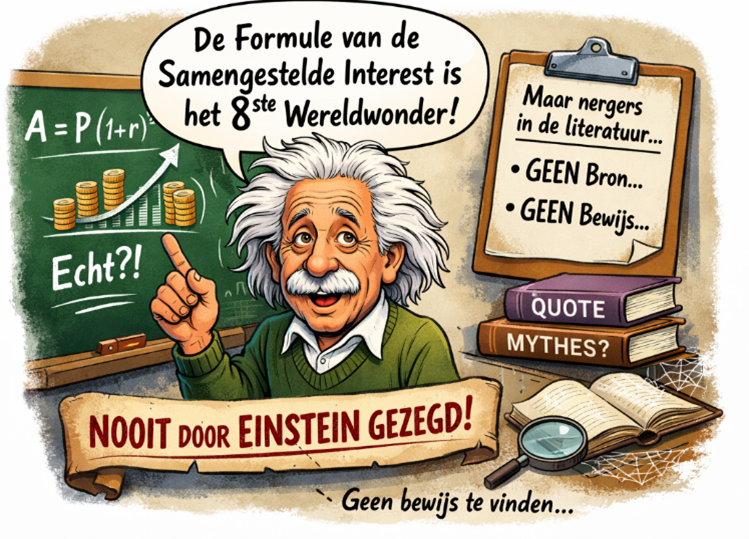
You've probably already heard of the Einstein bill, the Liberal Party's political proposal “Other”. Chairman Frederic De Gucht wants to encourage citizens to start investing on the stock market as early as possible and thus allow them to build up substantial capital over time. Start as early as possible, because this is how the 8th wonder of the world of composite interest can do its best, is the message. Many attribute this statement to Albert Einstein. However, there is nowhere in the literature that Albert Einstein would ever have said this, but it is more commonly used in financial marketing.
At the end of 2025, 301.9 billion euros were parked in our country's regulated savings books. The Anders party wants to mobilize that gigantic amount of money and stimulate the population's stock market participation. They also want to allow capital to flow to European companies to strengthen the economy.
The Anders Party even provided a practical example to make it understandable and more tangible for the general public. If you invest 100 euros (1,200 euros per year) every month from birth, with an average annual return of 7%, you may have saved a capital of 1.6 million euros by the age of 67. Based on historical returns, we do not think that is impossible with a basket of listed European stocks. In addition, that return can be increased if you can deduct 40% annually from your tax return!
In itself, this is of course a very good idea. Instead of “parking” your money in savings accounts that cannot keep up with inflation and thus make the population poorer, investing in listed stocks has historically paid a lot more in the long term. But of course you have to take more risks for that. Finally, you buy a part (share) of a company that takes risks to create value.
We can only remember two important laws in Belgium that fundamentally stimulated and encouraged investing in listed stocks: the 1982 Cooreman-De Clercq Act and its successor, tax-favourable pension savings as a third pillar. All other laws in Belgium were intended just the opposite, namely to tax investors more and more. It is also remarkable that this higher taxation has occurred every time the Flemish liberals were in the National Government.
The evolution of investment taxation

The fact that the Liberal Party is now making a change at the low point in the number of voters (5.8% national) and wants to make investing in the stock market more attractive again seems a wise choice. These systematically increased taxes on capital will have cost the Liberals a lot of voters. Frederic De Gucht must do something to win back those lost voters. The liberals traditionally stand for lower taxes, economic and individual freedom and a government that focuses on its core tasks (such as justice, security and education). The problem, of course, is that there are few other parties in Belgium that want to encourage investment on the stock market (quite the opposite). So the question is whether this proposal has any chance of success. In addition, the Anders party must win voters and be able to go back into government first.
The question is whether that government should be concerned with organizing games of chance? In any case, the gambling companies sell “sky” or “dreams” in their advertising slogans. The following National Lottery slogans make this all too clear: “Millionaires wanted”, “Get scandalously rich”, “Play where and when you want”, “You'll never win alone”, “Together we'll make dreams come true”, “Do your thing” and “With Joker+, every day is your lucky day”.
Lotto loss chance: 99.99998772%
Here we would like to take a moment to consider the chances of winning and losing the 2 most important lottery games in the National Lottery. The chance of winning the 6 correct numbers in the Lotto is 1 in 8,145,060 or 0.00001228%. The chance of losing is inversely proportional, 99.99998772%. The chance of winning the top prize with Euromillions is even smaller, 1 in 139.838,160 or 0.00000072%, so the chance of not winning it is 99.99999928%. By the way, all statistics with the chances of winning are in the official rules of each game. But only a few people probably read that and the National Lottery's marketing department will understandably not include these chances of winning or losing in its advertising messages.
The National Lottery just published the press release on the 2025 annual results. A record amount of 1.666 billion euros was invested in 2025, 7.3% more than in 2024. The press release states: “1.266 billion “profits” were paid out”. If we are able to calculate correctly, for all players combined, those 1.666 billion euros are the total costs and the 1.266 billion euros are the total revenues. So all players together lost 400 million euros in 2025. Of course, that amount (after deducting various costs, including operating costs and advertising) goes to charities.
In 2025, there were 323 million gaming moments in the National Lottery, with the average bet per game moment being 5.2 euro. In Belgium, there are 2,367,254 identified players. On average, those 2.4 million Belgians gamble at the National Lottery of Belgium for an amount of 704 euros annually.
But, make no mistake. In Belgium, there is a lot more gambling than through our own National Lottery. According to statistics from the Gaming Commission, the total gambling market will grow by 10% per year between 2019 and 2023, from 22.68 billion euros to 33.0 billion euros. In the 2024 annual report published in October 2025, we looked for the statistics for 2024. In the table of contents, we looked for Chapter 4 “the gambling market in numbers”. Scrolling to page 32, much to our dismay, we read the following paragraph:
Wanted: full time employee
“Collecting, controlling and processing financial data requires at least a full-time employee of the Gaming Commission (KSC) secretariat. As this position is currently not filled, it was not possible to provide reliable data in this report, even though it was intended to include the 2024 financial data in this report. The KSC deeply regrets this situation, but since it has no autonomy in the recruitment process, it unfortunately does not have the necessary means to do anything about it. As soon as possible, the financial data for the year 2024 will be published.”
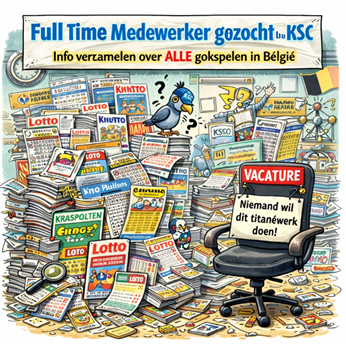
We made inquiries with the Gaming Commission. The answer we received is that the 2024 figures are being finalized, but that the annual report still needs to be drawn up afterwards. The publication of the 2024 figures will therefore probably only be posted on the website in the spring of 2026. A very bizarre fact, though. The Gaming Commission must control the gambling companies. But is having trouble recruiting one administrative assistant to collect the figures. Would the FSMA allow a listed company to publish its figures more than 15 months after the closing date?
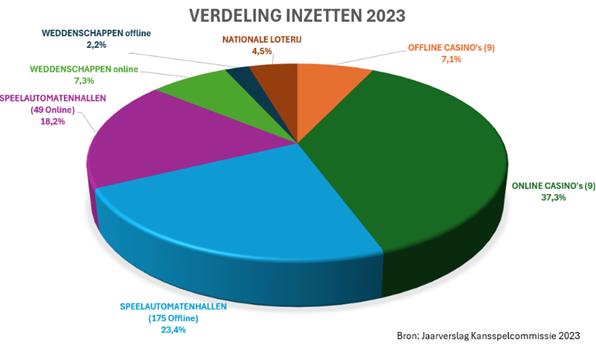
In the 2024 annual report of the National Lottery, we found this sentence: although the National Lottery represents barely 4% of the global turnover of the total gambling market. From this, we can deduce that the global bet on the Belgian gambling market (1.553 billion euros divided by 4%) was 38.8 billion euros. We suspect that the Belgian gambling market will therefore have exceeded 41 billion euros in 2025. In addition to the National Lottery, the major gambling providers include Gaming1, Napoleon Sports & Casino, Bingoal and Betfirst. But the majority (44.4%) of the total bet in 2023 of 33 billion euros came from the Casinos (7.1% Offline and 37.3% Online). See distribution on the pie chart:
Belgium has approximately 11.825 million inhabitants. A Sciensano health survey shows that 31.9% of the Belgian population participated in a game of chance at least once in 2023—2024 (lottery, sports betting, casino, scratch cards). That is 3.77 million inhabitants. In other words, the gambling Belgian gambles an average of almost 11,000 euros per year.
Another one bites the “Dust”
There are very few who go home with the jackpot. For each winner, there are thousands of others who — figuratively — bite the dust. “Another one bites the dust,” Queen's Freddy Mercury sang.
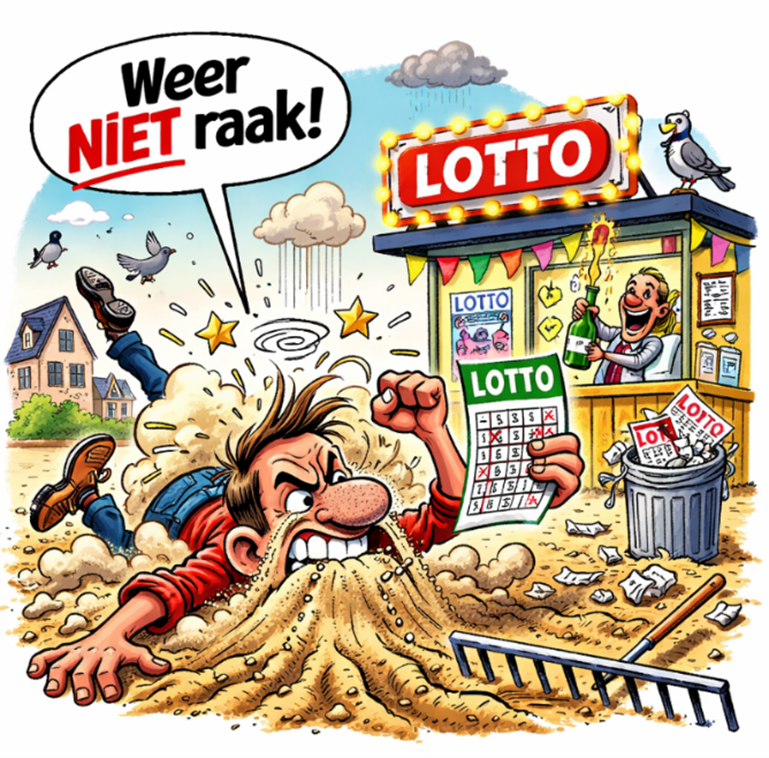
Investing is not the same as buying a lottery ticket. It's participating in entrepreneurship, innovation, growth. And yes, there have been missteps in the stock market. West Flanders undoubtedly remembers Lernout & Hauspie. The movie Dust reopens old wounds. But one derailed story does not make the stock market a casino. The difference is fundamental: those who gamble are playing against statistics. Those who invest benefit from the growth of companies. In the long term, it is not chance that wins, but the value creation of the companies. They usually succeed in passing on the increased costs (inflation) in their end products.
Perhaps the government should train everyone a little more about savings and investments through the education system. We can only encourage Frederic De Gucht's proposal to channel part of our dearly earned savings to the stock market.
With the 41 billion euros in annual bets in the gambling industry in Belgium, for example, you can buy the 4 largest Belgian listed investment companies alone (GBL, D'Ieteren, Ackermans & van Haaren and Sofina). According to Value Square's fundamental value creation study, these provided an average annual value creation of 7.24% over the period 2014-2024. Coincidence or not, that is roughly the same as the interest rate that the Anders Party uses for its Einstein account.
In addition to the 300 billion euros in savings books, the government may also try to mobilize those 41 billion euros in “annual” bets in the gambling industry to improve or at least maintain the purchasing power of the general population instead of selling dreams.
Author: Patrick Millecam
