

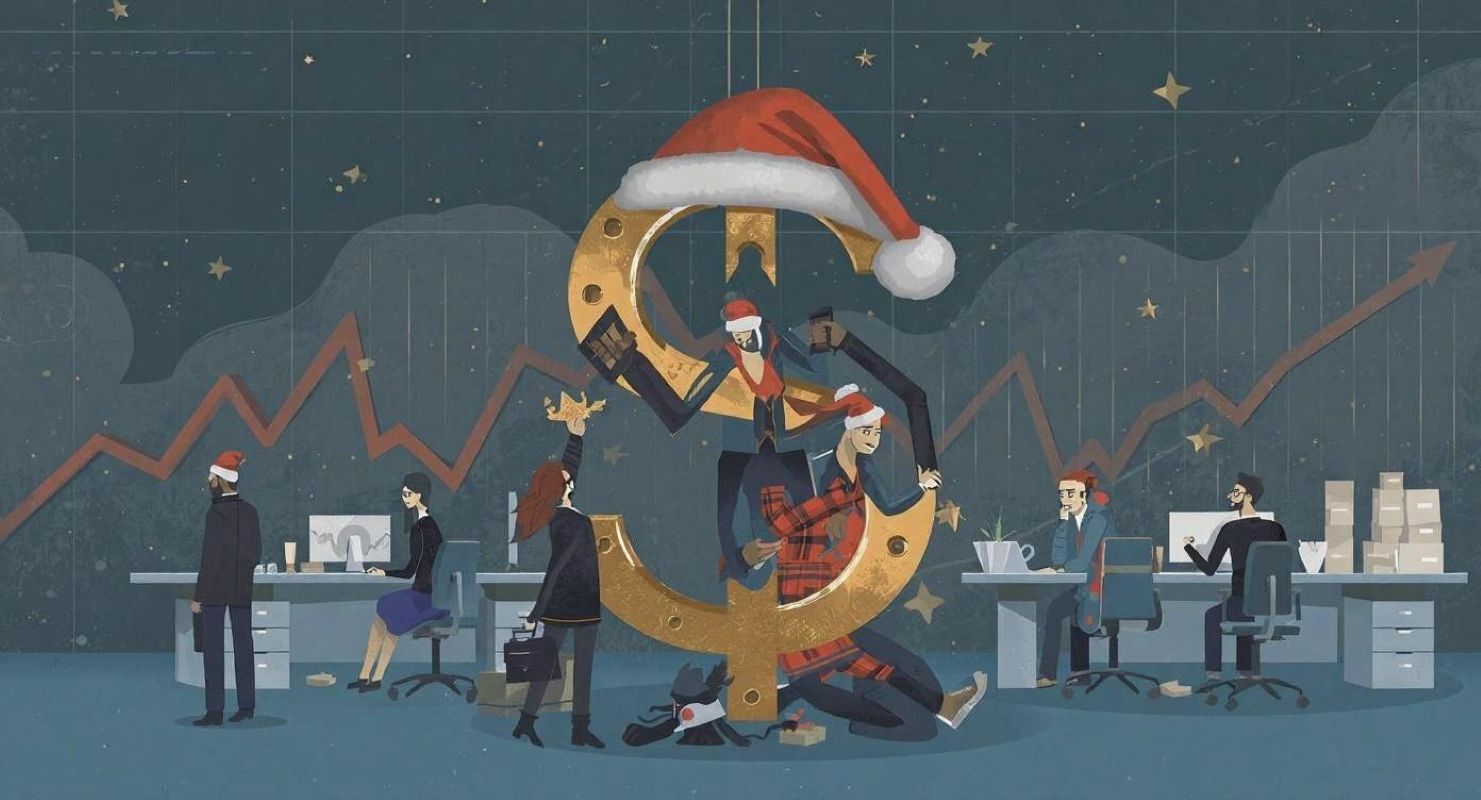
End-of-year effects on the stock market
The stock markets are gradually in Christmas mode. So it's time to zoom in on a number of typical end-of-year effects. After all, behind the party lights and the obligatory “best wishes” emails, there are a number of annual patterns in the markets. These end-of-year effects mean that prices sometimes take strange jumps without fundamental news at the basis. For the attentive investor, these are not mysteries, but mechanisms that come up year after year. And sometimes it can be used to the advantage...
Let's take a look at the most important ones.
Tax loss harvesting: selling with a heavy heart
A classic in countries where realised capital gains are taxed: tax loss harvesting. Investors sell positions that are at a loss so that those losses can be deducted from previously realized profits for tax purposes. The result? Stocks that were already struggling anyway will get an extra hit by the end of the year.
For Belgian investors, this has so far been something to observe with little jealousy. But starting next year, we can also participate in this game. This means that from next year, end-of-year effects on Belgian small caps will probably become more visible than we are used to historically.
The result is predictable: underperformers from the past year are sold, often regardless of their prospects. And what is sold sometimes falls further than is rationally justifiable.
Wallet cleaning: window dressing with a duster
Professional fund managers are also people. And people don't like embarrassing photos, just ask Mr Trump and Mr Clinton.
At the end of the year, professional investors will take a photo of the portfolio. That's why some have the bad habit of trying to clean up that photo by the end of the year: positions that performed poorly last year are sold so that they do not appear on the annual report. This so-called window dressing reinforces the same effect as tax loss harvesting. Losers are being sold, not because they suddenly got worse, but because no one wants to “show” them anymore. The stock thus receives a second penalty, purely for aesthetic reasons.
It gives attentive investors — and fund managers who don't care about aesthetics — the chance to catch that ugly duck before it transforms into a beautiful swan.
Low volumes, quiet markets and noisy lists
Between Christmas and New Year, the stock market often runs at half speed. Many professional investors are on leave, trading volumes are falling and order books are becoming thin. In such an environment, one relatively large order can already be enough to send a price a few percent — often without fundamental news in return.
It is precisely in that context that the annual favorite lists on. Banks, analysts and self-proclaimed stock market gurus present their “top picks for 2026”. The impact is usually limited for large, liquid stocks, but with small and micro caps, such a listing can suddenly cause considerable buying (or selling) pressure. A few extra orders in a market with low liquidity are sufficient to move the price considerably, regardless of the underlying business reality.
For active investors, it sometimes offers unexpected opportunities that can be taken advantage of.
Venom in the tail
On top of that, there is another less pleasant end-of-year phenomenon: Some bad guys opt to send out a press release just before Christmas or New Year, announcing a carefully saved dose of bad news. Bad news: strategic timing so, hoping it gets buried under turkey and champagne. And not caught by the press and the public.
Large companies have usually learned that trick — trust comes on foot and goes by — but it still happens occasionally with smaller listed companies. If you keep an eye on the investor relations pages during Christmas and New Year's Eve, you can sometimes find valuable (and timely) information here. You might have to catch an angry look from your other half or mother-in-law at the festive table...
Lastly
End-of-year securities are not magical stock market laws, but the result of human behavior, tax rules and practical reality. They create noise — sometimes annoying, sometimes interesting. For the long-term investor, they are primarily a reminder that price and value don't always go hand in hand, certainly not in December.
And who knows: while others are preparing their wallets for the winter, there's just an opportunity under the Christmas tree 🎄📈.
Author: Jens Verbrugge
