

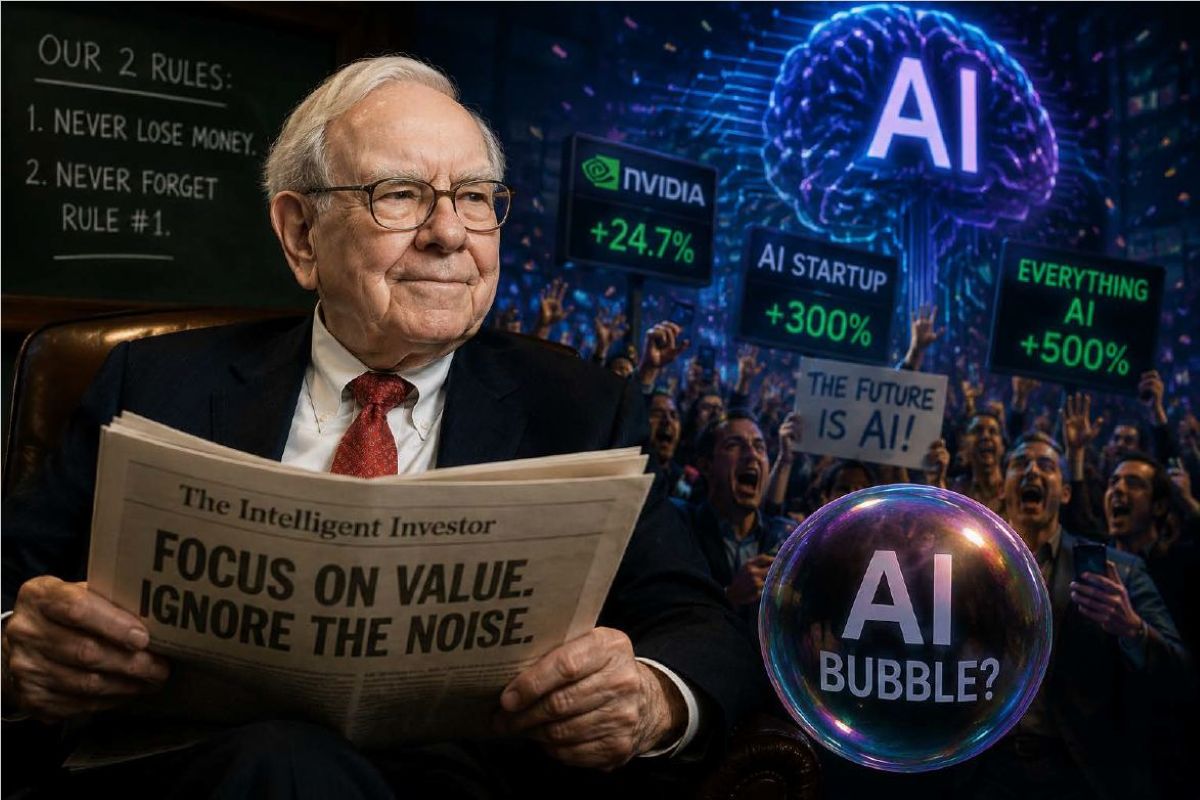
How would Warren Buffett react in times of AI mania?
The stock markets are currently completely dominated by artificial intelligence. Anyone opening the financial news pages is flooded with record figures, astronomical valuations, and a euphoric optimism reminiscent of the wildest episodes in stock market history.
In such a climate, it is tempting to ride the wave of enthusiasm. But at Value Square, we always ask ourselves the same question: when markets seem to be driven by emotion rather than facts, how would Warren Buffett view this?
Buffett, the 'Oracle of Omaha', built his wealth over a period of more than eighty years by investing. Not by subscribing to the hype of the moment, but by consistently adhering to a number of fundamental principles. He and his partner Charlie Munger distilled these principles from decades of market experience. They are timeless, which is precisely why they are particularly relevant today.
In our blog '10 investment lessons from Warren Buffett' (http://www.value-square.be/blog/10-beurswijsheden-van-warren-buffett) we previously explained these principles. In this article, we resolutely apply them to today's AI frenzy: the insane investments by the hyperscalers, the upcoming IPOs,…
What should a prudent investor do in this climate?
The AI hype: technological revolution or bubble?
Let us start with an honest observation: AI is not an empty hype. The technology is real, the possibilities are impressive, and the impact on our economy and society will be profound. No one doubts that. The question an investor must ask is not whether AI is important. The question is whether the current stock prices of AI companies already correctly reflect that future, or whether investors have already priced in too much optimism.
That question has a historical parallel. In the late 90s, the internet was a true revolution. But that did not prevent countless companies with minimal revenue from being valued as if they were the future giants of the economy.
The lesson from the dot-com bubble is not that technology is dangerous. The lesson is that even the most transformative technology is no guarantee that all early players will become structural winners. And certainly not at any price.
"Hypes, however, usually do not arise from things that have no value. In most cases, a few winners do indeed emerge. But they drive the price far above the intrinsic value and underestimate the effect of increasing competition on many of the emerging players." — Value Square, '10 investment lessons from Warren Buffett'
Today we see exactly the same pattern. The technology is real. The winners of tomorrow are undoubtedly already there. But who exactly are they? And are they already priced as winners, or is there still margin for the investor?
The question is not whether AI is useful. The question is whether the companies that currently dominate the market will still hold the same position in five or ten years, and whether their valuation today already fully reflects that position while also building in a substantial premium.
"Invest in companies with an economic moat — a sustainable competitive advantage that is difficult for peers to bridge." — Value Square, '10 investment lessons from Warren Buffett'
The hyperscalers and their capital expenditures: who pays the bill?
The most concrete expression of the AI frenzy is the astronomical investment by the so-called hyperscalers: the large tech companies that manage the world's cloud infrastructure.
The capital expenditures of the major AI players are rising to more than 700 billion dollars, almost as much as the entire gross domestic product of Belgium. These are investments in data centers, servers, electricity grids, and the chips needed to train and run AI models.
The central question every level-headed investor must ask themselves: is there enough revenue in prospect to justify these investments?
The honest answer is that we don't know. And that is precisely the problem. The hyperscalers are all betting on the same future simultaneously, in a race where no one can afford the luxury of stopping, even if the return on investment remains unclear. Analysts at Mizuho have openly written that pessimistic investors might view a potential doubling of capital expenditures as a red flag, resulting in limited free cash flow and an uncertain return on investment.
"Cash flow is more important than profit. Profit can be manipulated by accounting tricks, but cash flow does not lie." — Value Square, '10 Stock Market Wisdoms from Warren Buffett'
Buffett has always emphasized that he focuses on real cash flows, not on paper profits or future promises. A company spending hundreds of billions without a clear return would raise his eyebrows, no matter how impressive the technology is. That said, the hyperscalers themselves do have robust, existing business models.
The lesson of the dot-com bubble: on winners and losers
It is tempting to think that AI is different from previous technological waves, and in a sense, it is. But the pattern of investor euphoria has repeated itself throughout history with almost mechanical regularity, as the chart below demonstrates:
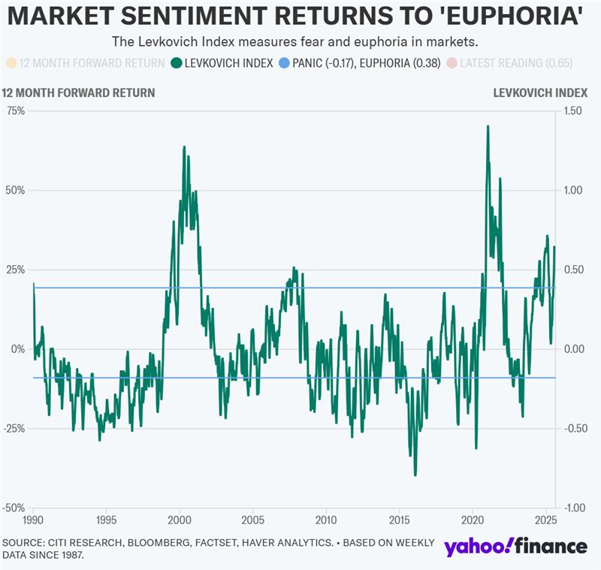
The tulip mania of the seventeenth century. The railroad bubble of the nineteenth. The radio bubble of the 1920s. The bowling bubble of the 1950s, which drove bowling centers to absurd valuations. The dot-com bubble of the late 1990s. In each of these episodes, there was a core of real value. However, markets massively overestimated how much companies would benefit, underestimated the competition, and forgot that even good companies can be too expensive.
The dot-com bubble did indeed produce a number of winners, but above all, it left behind hundreds of companies that no one remembers today. The investor who blindly invested in 'the internet' in 2000 via a basket of internet stocks lost a significant portion of their wealth. The investor who patiently waited for the correction and then chose selectively did exceptionally well.
"The stock market is a device for transferring money from the impatient to the patient." — Warren Buffett
Buffett has always said that he does not know when the market will fall, but he is certain that at some point, it will correct stocks that are overvalued. In the meantime, he argued, it is the investor's job not to let their principles be undermined by market noise.
AI mania through the lens of Warren Buffett
How would Warren Buffett view the current AI climate? Based on his documented principles and historical decisions, we can make a reasonably well-founded estimate.
He would analyze the hyperscalers critically, not embrace them blindly.
Buffett does not invest in sectors or trends; he invests in companies. For each of the hyperscalers, he would ask: what portion of the share price is based on existing earnings, and what portion is a bet on a future AI scenario? His decision to stay in or get out would be determined if that second part becomes too large.
Patience is not a weakness, but a strategy.
Berkshire Hathaway has been sitting on a record-high cash position of nearly $400 billion for some time. Buffett has not described this as a problem, but as an asset. Those who have cash when others are panic-selling can secure the best deals at that moment. Patience is not a weakness, but a strategy.
"It's far better to buy a wonderful company at a fair price than a fair company at a wonderful price." — Warren Buffett
He would look for the overlooked winners of AI.
In the dot-com bubble of the 1990s, it wasn't the website creators who made the most profit, but the companies that provided the infrastructure: the cable companies, the chipmakers, the logistics players. Are there companies benefiting from AI without carrying the astronomical hype valuation?
He would scrutinize the balance sheet and cash flow of every company.
Hyperscalers are spending hundreds of billions, partly financed by debt. Buffett has always warned against companies that rely on external financing to realize their growth plans. A company that must fund its future through capital markets is vulnerable, especially if those markets ever become less accommodating.
Our perspective as value investors
At Value Square, we are not tech skeptics. We follow the AI revolution with great interest and recognize that there are companies that will structurally benefit from this transformation in a way that justifies their stock price or has not yet been fully priced in.
But our approach remains the same as always: we fundamentally analyze companies. We look at cash flows, balance sheets, competitive positioning, and management. We don't buy stories; we buy companies.
In the current market, that means we are cautious with the most hyped AI names, which are trading at valuations that leave little room for disappointing results. We pay extra attention to companies that benefit from the AI infrastructure boom without being plagued by hype-driven valuations. And we guard our cash reserves as a valuable asset for when the market offers us better prices.
Because ultimately, the law of gravity applies here too. Prices that drift too far from reality always return. We know this from history. And Buffett has taught us that this is not something to fear, but something to prepare for.
"The best thing you can do is to keep learning." — Warren Buffett
Conclusion: Buffett's lesson is your lesson too
In the current market climate, Warren Buffett would not panic, nor would he ride the wave of euphoria.
One of the greatest risks for investors in a hype-driven environment is FOMO: Fear Of Missing Out. It is an emotion that drives investors to make purchases they would never consider under other circumstances.
Warren Buffett's principles are simple: buy companies, not stocks. Analyze cash flows, not stories. Avoid the hype. Keep your balance sheet strong. Be patient and be greedy, especially when others are fearful.
At Value Square, we believe the best way to navigate the AI revolution is the same as it has always been: with a clear head, sharp analysis, and the timeless principles of the greatest investor the world has ever known.
Would you like to review Warren Buffett's ten investment maxims again? Visit our blog at www.value-square.be/blog/10-beurswijsheden-van-warren-buffett.
Disclaimer
This article is intended for informational purposes only and does not constitute investment advice. Investing involves risks, including the risk of losing the invested capital. Past performance is no guarantee of future results. Value Square NV is a licensed asset manager supervised by the FSMA.
Author: Petrick Step
