


In the shadow of tech violence, small US stocks are also breaking records
The Russell 2000, the most important U.S. index for small stocks, has set a record for the first time since 2021. This is a boost in a market that is dominated by major tech giants.
While the major US indexes are stringing up the records, US stocks with smaller market caps are also doing very well. The Russell 2000, an index that tracks the performance of small US stocks, also quietly reached a record high. This brings an end to a four-year waiting period. Since the bottom after Liberation Day on April 2, the index has been more than 36 percent higher, measured in dollars. That's better than the S&P500 (+32%).
Among the 100 most traded stocks on the pan-European stock exchange, there are four Belgian stocks: AB InBev (39 between Safran and Campari), Argenx (73), UCB (82) and KBC (93). The share of Dutch chip machine manufacturer ASML is the only one that recorded more than 4 million transactions on Euronext.
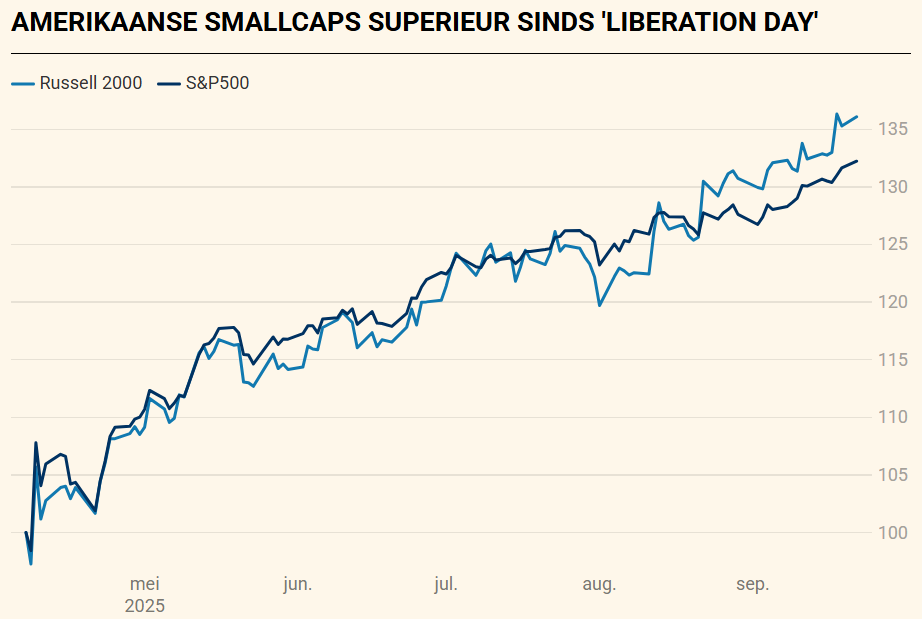
The Federal Reserve's interest rate cut on September 17 was a decisive catalyst. For small caps, interest rate decisions outweigh any other factor. The Fed cut the policy rate to 4 to 4.25 percent, and the market is counting on two more cuts this year. This creates a more favourable environment for smaller companies, which are more sensitive to financing costs. In addition, they benefit from US President Donald Trump's tax cuts. These mainly benefit companies with activities in the Netherlands.
Nevertheless, the relative backlog remains significant. Compared to the Russell 1000 (an index with larger companies) and the Russell Top 50 (the mega caps), the small cap index has been performing weaker for years.
Sustainable rally?
The question is whether the advance is sustainable and whether the broad market can finally benefit from a stock market dominated by major tech companies. In the event of new rate cuts - which are expected but not guaranteed - the rally may continue, strategists believe, although this will not apply to all small caps. “Interest rate reduction cycles mainly favor higher quality small caps: companies with healthy balance sheets and often the bigger names in the Russell 2000,” says Jill Carey Hall, a Bank of America strategist.
Interest rate reduction cycles mainly favor higher quality small caps: companies with healthy balance sheets and often the bigger names in the Russell 2000. - Jill Carey Hall (Startege bank of America)
HSBC points out that half of corporate debt in the Russell 2000 is variable, compared to only 10 percent in the S&P 500. So interest rate cuts are a direct tailwind, but vice versa, the same applies to interest rate rises. In addition, 40 percent of the companies in the Russell 2000 are loss-making, especially in profitless tech and early biotech.
Belgian investors who want to invest in the Russell can do so via various ETFs listed on European stock markets. The spread within the index is enormous. Some companies have a market value of barely 100 to 150 million dollars, while the largest ones are around 7 to 8 billion dollars. The average market capitalization of a Russell 2000 company is 1.3 to 1.5 billion dollars, with a median of approximately 700 to 800 million dollars.
European counterparts
When you compare that to European companies, it is striking that American small caps are often larger than their European counterparts. On Euronext, in the BEL Small or in the German SDAX, many companies operate in a market capitalization range of 200 to 800 million euros.
Companies above 2 billion euros are quickly considered a mid-cap in Europe, while those in the US can still fall under the Russell 2000 umbrella. In Belgium or the Netherlands, for example, a market value of 5 billion euros is often already considered a large cap, while in the US it is still mid-range.
MSCI's European small cap index has already gained more than 9 percent this year. The basket of 836 European companies is still 5.4 percent below its 2021 peak. The index trades at a substantial discount compared to its US counterpart. While the Russell 2000 is trading at an expected price-to-earnings ratio of approximately 25, MSCI Europe Small Cap shares trade around 14 times expected earnings. This means that European small caps are on average around 44 percent cheaper than their American counterparts.
References
- Source: De Tijd
- Link: In the shadow of tech violence, small US stocks are also breaking records | The Times
- Author: Christophe De Rijkce
- Photo: Fed Chairman Jerome Powell. Last week's US interest rate cut was an additional catalyst for small caps. ©REUTERS
- Date: 23/09/2025
