


Verdant Bioscience - A new step towards more sustainable and productive palm oil
Report by Patrick Millecam of the trip to Indonesia organized by SIPEF from September 20 to October 4, 2025, more specifically from the visit to Verdant Bioscience.
1. What is Verdant Bioscience and who is behind it?
Verdant Bioscience (VBS) is a Singapore-based research company that specializes in developing new types of oil palm seeds that produce more oil per hectare.
Two Belgian companies, SIPEF and Ackermans & van Haaren (AvH), are Verdant's main shareholders. Together, they own around 80% of the company (SIPEF 38%, AvH 42%).

Verdant was founded in 2013 with one big ambition: to make the oil palm plant (Elaeis guineensis) more productive, healthier and more sustainable — not through genetic engineering, but through traditional breeding (targeted crossing of parent plants).
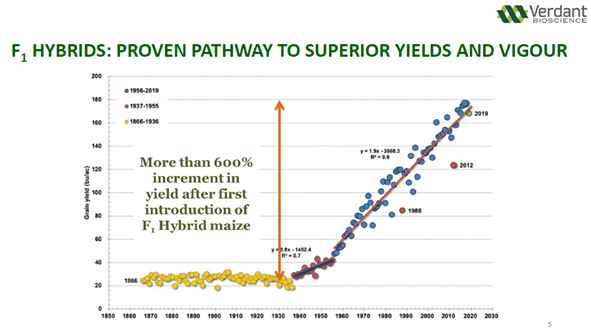
The ultimate goal is to bring the first F1 hybrid oil palm seeds to market by 2029. Such hybrids have been around for decades in other crops such as corn and tomatoes and have led to huge increases in yield. See graph for hybrid maize, evolution in yield (in bushels per acre).
2. What are F1 hybrids?
Verdant develops F1 hybrid oil palm varieties by crossing two (almost) fully homozygous parental lines obtained through advanced breeding, tissue culture and double haploid technology1. This results in genetically uniform seeds with higher yield potential and greater predictability in cultivation.
An F1 hybrid is a first-generation cross between two carefully selected parent plants. Because these parents are genetically very different, their descendants develop a natural phenomenon called “hybrid power”: the plants grow better, are more uniform and yield more.
This is much more difficult with oil palms than with corn. The oil palm only bears the first clusters after 2 to 3 years. Assessing new F1 lines takes time: in addition to the maximum yield, certain characteristics must also be measured, such as oil yield, fruit size, growth rate, stem height, disease resistance and oil quality. Because the palm only reaches its peak around years 8—10, multi-year data is needed to reliably validate the results.
Verdant Bioscience therefore uses modern breeding techniques such as “double haploids” — a method to create pure parental lines more quickly, without genetic manipulation.
The result is parent plants with stable properties, which are then crossed with each other to produce the ideal F1 offspring: palms that produce more oil, are more resistant to diseases and cope better with drought or poor soils.
1 (*) A haploid plant contains only one set of chromosomes (n) — half the normal number. Such plants can be obtained from: pollen cells (microspores), oocytes (megaspore mother) or via androgenesis/gynogenesis in the laboratory. Because haploid plants are unstable and sterile, their chromosomes are artificially doubled. The result is a double haploid (2n) — a plant with two identical sets of chromosomes, so completely homozygous.
3. What do these F1 hybrids actually mean in terms of yield?
The oil yield per hectare depends strongly on the quality of the plant material. According to Verdant's studies, roughly the following applies today:
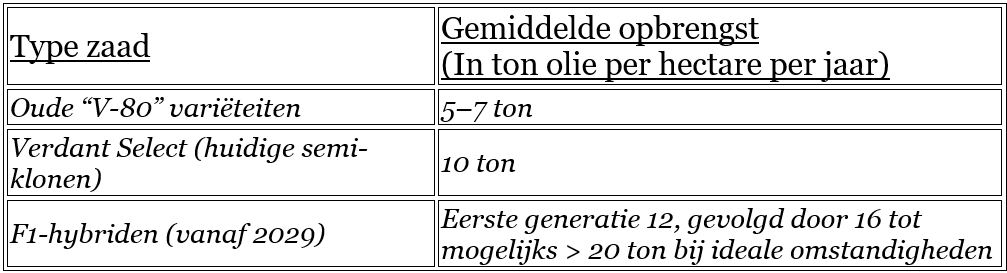
The 9 tons per hectare can be reached at very convenient locations; on a commercial scale, this may be somewhat lower in yield. Verdant expects its new F1 seeds to generate a significantly higher yield (up to 50% or more). In the longer term (> 10 years), this could even produce up to three times more oil per hectare than the current generation of oil palm seeds.
That means more production on the same surface — so no need for additional deforestation or new plantations.

In addition, these higher revenues also result in lower production costs per tonne of oil, helping SIPEF to become more profitable, even with fluctuating market prices.
The F1 hybrid seeds will not immediately produce 15 tons of palm product (palm oil +palm kernel oil) per hectare. The research is still in an early phase. The first results are promising, but management also wants to exercise caution. In addition, the existing plantations will be replanted at a rate of 4% per year with these new high-yielding seeds, which will therefore only be reflected in the production figures very gradually.
4. Disease resistance — the fight against Ganoderma
One of the biggest enemies of the oil palm is the Ganoderma fungus. It affects the trunk and roots, causing trees to die and yields to fall sharply, especially when replanting. That is why Verdant has a separate section in her research that focuses on disease resistance.
Each new cross type is first tested in the laboratory for sensitivity to Ganoderma, drought and nutritional deficiencies.
The best crosses are then planted in fields with high disease pressure, to see which genetic combinations are most tolerant.
Only the hybrids that continue to perform well under these difficult conditions will be further developed. The aim is to offer commercial plant material that clearly shows fewer losses after replanting and thus offers a major economic advantage for planters.
5. Healthy soils as a basis for healthy yields
Higher yields can only be maintained if the soil also remains in good condition. That's why Verdant also pays a lot of attention to sustainable farming practices that restore the soil instead of depleting it. Their programs include:
- Smart fertilization: Analyses of leaves and soils determine exactly which nutrients the plant needs. This avoids waste and reduces fertilizer costs — often more than 50% of the “field” costs.
- Use of biochar: this is a type of charcoal made from plant residues, which helps the soil retain moisture and nutrients better.
- Compost and natural nitrogen fixers: by growing crops that fix nitrogen (such as legumes) and returning organic matter to the soil, soil life remains active and healthy.
- Controlling erosion and water management: Verdant measures how well water penetrates the soil and installs drainage systems to prevent mud and nutrient loss.
- Gentle crop protection: people mainly use natural enemies (such as beneficial insects) against pests and only chemical agents when there is really no other option.
This approach ensures sustainable productivity: not only high yields now, but also within ten years.
6. The role of laboratories and research sites
Verdant has its own research and seed production center in Indonesia. There, scientists are testing hundreds of crosses at the same time, each with their specific properties. They also have a tissue culture laboratory, where they can propagate plants from small pieces of a single parent plant in a controlled way.
This allows them to produce hundreds of thousands of genetically identical plants, which is essential to provide sufficient F1 seeds as soon as the commercial phase starts. The entire process — from crossing to usable plant — takes about three to four years. Subsequently, the F1 hybrid seeds still need to be tested in the field, which also requires at least 7 years of data, to be able to sell these seeds commercially.
7. The schedule and timeline
The development of such seeds requires time and a lot of patience:
1. 2013—2020: establishment and basic research.
2. 2021—2024: first test fields with dozens of F1 intersections; the first results look promising.
3. 2025—2028: refining selection; expanding production capacity.
4. From 2029: Commercial launch of the first F1 hybrids.
5. 2030 and beyond: large-scale replanting with F1's; yield per hectare increases gradually as more plantations switch.
It is therefore a multi-year strategy, but with potentially permanently higher returns and a lower environmental impact.
8. Why this is important for SIPEF and AvH — and for the environment
The collaboration with Verdant is both an economic and ecological investment for SIPEF and AvH.
Economical:
- Higher yields mean more oil without extra land.
- Lower costs per tonne of oil improve profitability.
- Better genetics make production more stable, even in difficult weather conditions.
Ecological
- By producing more on existing plantations, you do not have to cut down forests.
- Healthier soils and fewer chemicals protect biodiversity and water quality.
- Verdant is fully in line with the goal of “more with less” — more food and energy crops with less pressure on the environment.
9. What can we expect in the coming years?
- Verdant continues to test new crosses every year, including on the SIPEF plantations.
- The first commercial F1 seeds will be available from 2029, with a priority for shareholders.
- As more palms of the new type are planted, yields per hectare will increase visibly. The replanting will be done gradually based on a replanting schedule. Where the F1 hybrids are planted, it is expected that people will see an improvement step by step towards maximum potential in the long run.
In this way, SIPEF can produce the same amount of oil on less land in the future, while contributing to a more sustainable palm oil sector.
10. Summarized
- Verdant Bioscience is developing new oil palm seeds that provide much more oil and are less susceptible to diseases.
- The project is not genetically modified, but based on smart cross-breeding and selection.
- SIPEF and AvH are main shareholders and will be the first to benefit from the new seeds.
- Expected yield: approximately 6 to 8 tons of crude palm oil. If we also add palm kernel oil, this could amount to 8 to 10 tons of “palm” product. In the very long term, if all existing areas have been replanted, the yield per hectare can still increase significantly.
- At the same time, Verdant works on healthy soils, environmentally friendly pest management and efficient use of fertilizers.
- The first commercial seeds are expected in 2029.
- It is a long-term project, but with enormous added value for agriculture, the environment and investors.
