

Which Belgians are outperforming Warren Buffett?
Over the past decade, 14 Belgian listed companies have managed to create more value than Warren Buffett’s American holding company, Berkshire Hathaway. The biotech firm Argenx generated the most value for its shareholders.
This week, Argenx received the Golden Value Creation Award from Value Square. Since 2007, the Ghent-based asset manager has calculated the fundamental value creation of Belgian listed companies over a ten-year period. To do this, Value Square looks at the evolution of equity, added to the net dividends paid out.
Although Argenx has never paid a dividend to its shareholders, its phenomenal growth over the past decade has created the most value: an average of 28.1 percent per year. "2025 was a particularly strong operational year, with an operating profit of over $1 billion and a net profit of $1.29 billion," explains asset manager Patrick Millecam. "Argenx succeeded in quickly rolling out its key product, Vyvgart, commercially. This groundbreaking drug is used to treat conditions such as the autoimmune disease myasthenia gravis (MG), which affects the muscles. At the same time, Argenx continued to expand its clinical pipeline to support future growth. Everything points to Argenx consistently reaching the podium in the coming years."
Argenx is far outperforming Berkshire Hathaway, where Warren Buffett, the reference shareholder, stepped down as CEO in late December to become chairman. Buffett, who appeared via an AI version at the awards ceremony in Ghent, achieved value creation of 11.5 percent per year over the past decade. However, the engine of the Omaha-based holding company is starting to run a bit slower. Since 1964, when Buffett took the reins at Berkshire, the average value creation has been 18.1 percent. The stock price rose even slightly more, by 19.8 percent per year. "That is a sign that the stock market is doing its job efficiently: in the long term, the price follows value creation," says Millecam. Buffett’s long-term track record remains excellent. He has delivered a positive return in 50 out of 61 years. In two-thirds of those years, he beat the broad S&P 500 index.
Top Recycler
While only nine Belgian companies managed to beat Buffett over a ten-year period last year, that number has now risen to 14. Campine took home the silver medal with value creation of 21.6 percent per year. The company, based in the Campine region, is the second-largest recycler of car batteries in Europe, extracting lead and plastics. It is also a top-three player in antimony trioxide, which is essential as a flame retardant. Campine has been benefiting from exceptionally high antimony prices for several years.
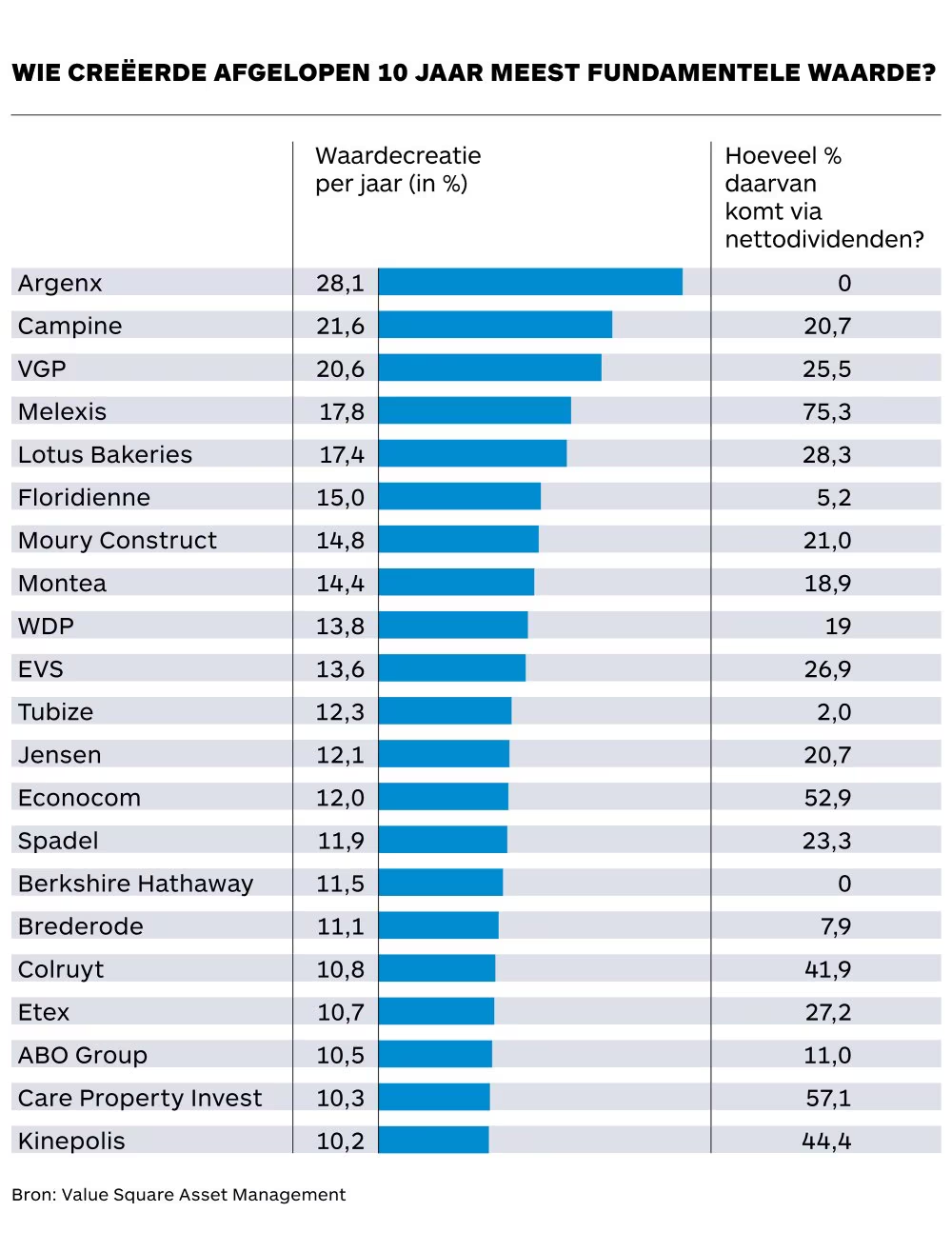
Warehouse developer VGP, last year's winner, occupies third place. Although its stock price is in a slump, VGP posted strong results last year, with its net asset value rising by 8.3 percent. Earlier this month, VGP raised 250 million euros from major investors.
It is striking that the stock prices of the 86 companies that made the Value Square list are lagging nearly 4 percent behind their value creation. While prices rose by an average of 3.7 percent per year, value creation increased by 6.8 percent annually. One cannot, therefore, speak of inflated prices on the Brussels stock exchange.
Dividend Leaders
The study also confirms a phenomenon our editorial team has previously analyzed: strong and consistent dividend payers perform well on the Brussels stock exchange. "If we set aside the increased dividend tax and two exceptional dividends at D’Ieteren, there are 14 companies that have increased their profit distribution for ten consecutive years or kept it at least stable," says Millecam. "Their average return on the stock market was 9.2 percent, almost exactly in line with their fundamental value creation of 9.3 percent. Both the stock market performance and the fundamental value creation are significantly higher than the average of all companies studied."
The 14 dividend leaders are, in alphabetical order: Ackermans & van Haaren, Ascencio, Brederode, Care Property, D’Ieteren, Elia, Etex (which is only listed on the Expert Market auctions), Fluxys Belgium, Lotus Bakeries, Recticel, Sofina, Texaf, Tubize, and UCB.
Finally, Value Square took a closer look at the holding companies. With annual value creation of 11.5 percent, Brederode just barely failed to surpass Berkshire. "It is not for nothing that founder Pierre van der Mersch was called the Belgian Buffett," says Millecam. "Although Van der Mersch retired at 89, a bit earlier than Buffett (who was 95, ed.)."
Following them are Ackermans (+9.6%) and Sofina (+7.8%) as the best performers. At the very bottom are Quest for Growth (+0.1%) and GBL (+3.2%). It is therefore no surprise that new CEOs and strategies have recently been proposed for these laggards.
References
- Source: De Tijd
- Link: https://www.tijd.be/markten-live/analyse/welke-belgen-doen-het-beter-dan-warren-buffett/10661082.html
- Authors: Serge Mampaey
- Date: 05/22/2026
